Vancouver Aquatic Centre: Winner of a 2025 Canadian Architect Award of Excellence
Published
This monumental project signals a new relationship between Vancouver’s diverse communities, its Indigenous Peoples and its waterfront histories. The building’s three dimensional form—essentially a vast roof—firmly anchors it on the shoreline, its eaves lifted to bring light and warmth to its vast interior hall. We applaud this project for its generosity, ambitious hybrid construction, and quiet material palette, all of which speak of Canada’s distinctive coastal geography and cultures. – Alison Brooks, juror
LOCATION Vancouver, British Columbia
Vancouver’s English Bay is one of Canada’s densest neighbourhoods, and a place of rich history. For millennia, the area known as a-ag-ulchun was the centre of cultural and ecological life in the Salish Sea for the (Musqueam), Skwxwú7mesh (Squamish), and (Tsleil-Waututh) peoples. Later, it became a recreational hub for the growing settler city, with the 1929 Crystal Pool, and later, the modernist Vancouver Aquatic Centre.
Designed by West Coast Modernist Duncan McNab with Thorsen & Sons Engineers, the 1974 aquatic centre was a bold expression of Vancouver’s civic ambition. The iconic monolithic form—trapezoidal and rising toward the bay—was achieved through a single, massive horseshoe-shaped steel box truss, supported on only four concrete columns (including the two dive towers). The walls, made from ubiquitous precast double-T beams, were simply tipped up and leaned gently inward—efficient, simple, elegant.
However, the aging 1974 Aquatic Centre is literally crumbling, and no longer meets standards for competition, seismic safety, efficiency, or comfort. MJMA and Acton Ostry initially explored renewing the existing structure, but a new-build was ultimately deemed more cost-effective and capable of delivering on ambitious sustainability and community goals.
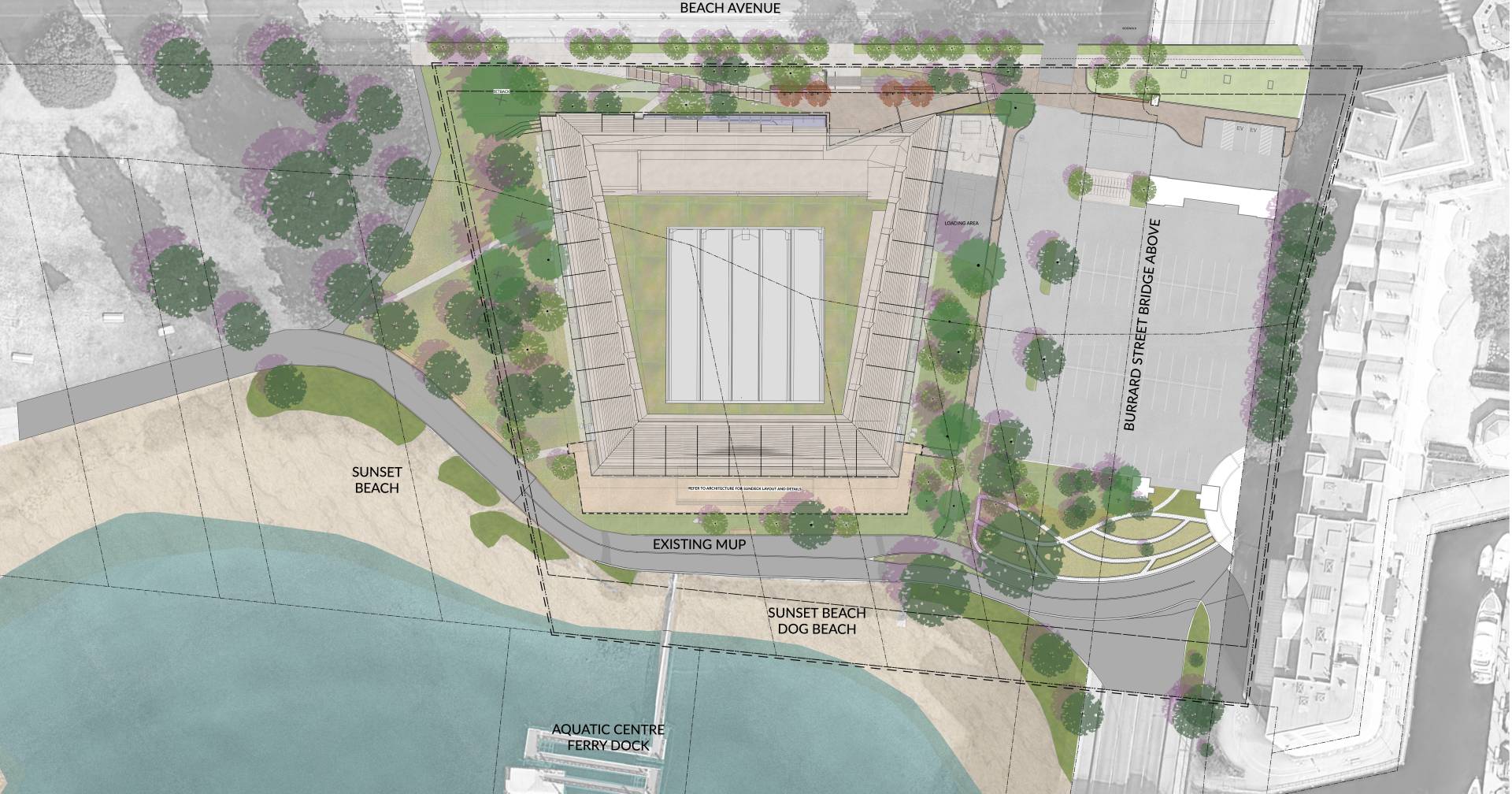
The new building preserves its predecessor’s footprint and sloping form. But now, six heroic steel trusses span nearly 50 metres from the lobby to the diving tower, linked by timber-clad sawtooth roofs that filter daylight deep into the plan like a set of gills. The original concrete walls are reinterpreted as inward-leaning mass timber beams, laced together with cross-laminated timber panels. A gently flared lower roofline allows water to softly cascade from the roof to nourish raingardens flanking the building. Transparency is introduced where once there was opacity—generous glazing along the pool deck offers sweeping views to Sunset Beach and English Bay, while a woven, textile-like timber screen along the south façade filters light and views.
The design’s lapped glass-fibre reinforced panel cladding and exposed mass timber interior reimagine the traditional Coast Salish plank house form, which featured massive cedar planks secured over heavy interior timber frames. Inside, movement unfolds as a choreographed passage from city to shore, echoing the ancient path from village to water.
As North America’s first Passive House aquatic centre, the renewed Vancouver Aquatic Centre aims to achieve exceptional energy efficiency and operational cost savings. Paired with advanced InBlue drum filtration, the facility will also deliver world-class air and water quality. De-carbonization is achieved via a fully electrified design that taps into British Columbia’s renewable hydroelectric grid, achieving zero operational emissions as well as delivering on the City of Vancouver’s 40% embodied carbon reduction mandate—an ambitious goal for a building typology traditionally marked by significant embodied carbon. The path to best-in-class embodied carbon relies on the use of ultra-low emissions concrete mixes, reuse of key carbon-intensive elements from the existing structure, and a bold expression of locally produced exposed mass timber structure.
CLIENT City of Vancouver | ARCHITECT TEAM MJMA—Ted Watson (FRAIC), Tarisha Dolyniuk (FRAIC), Chris Wanless, Leland Dadson, Andrew Filarski (FRAIC), Jeanne Ng (MRAIC), Robert Allen (FRAIC), Tim Belanger, Viktors Jaunkalns (FRAIC), Farhang Alipour, Zoe Razaq, Kyung Sun Hur, Tiffany Cheung, Melissa Lui, Melanie Taylor, Francis May, Evelyn Chin. Acton Ostry—Mark Ostry (FRAIC), Derek Fleming (MRAIC), Mark Simpson (MRAIC), J-R Marion, Gregory Aunger (MRAIC), Caio Martinho, Nicholas Perseo, Anthony Roach | STRUCTURAL RJC | MECHANICAL AME | ELECTRICALMCW | SUSTAINABILITY AME | CIVIL Aplin Martin | LANDSCAPE PWL | TRAFFIC Bunt & Associates | ACOUSTICRWDI | BUILDING ENVELOPE Evoke | CODE Thorson Consulting Certified Professionals | COST BTY | PRE-CONSTRUCTION MANAGER Heatherbrae | ENGAGEMENT Kirk & Co. | CULTURAL PLANNERS Ginger Gosnell-Myers and Cory Douglas | AREA 7,500 m2 | BUDGET $136 M | STATUS Construction Documents | ANTICIPATED COMPLETION 2029
TOTAL ENERGY USE INTENSITY (TEUI) 300-500 kWh/m2/year | THERMAL ENERGY DEMAND INTENSITY (TEDI) 30-100 kWh/m2/year | GREENHOUSE GAS EMISSIONS INTENSITY (GHGI) 6 kg CO2e/m2